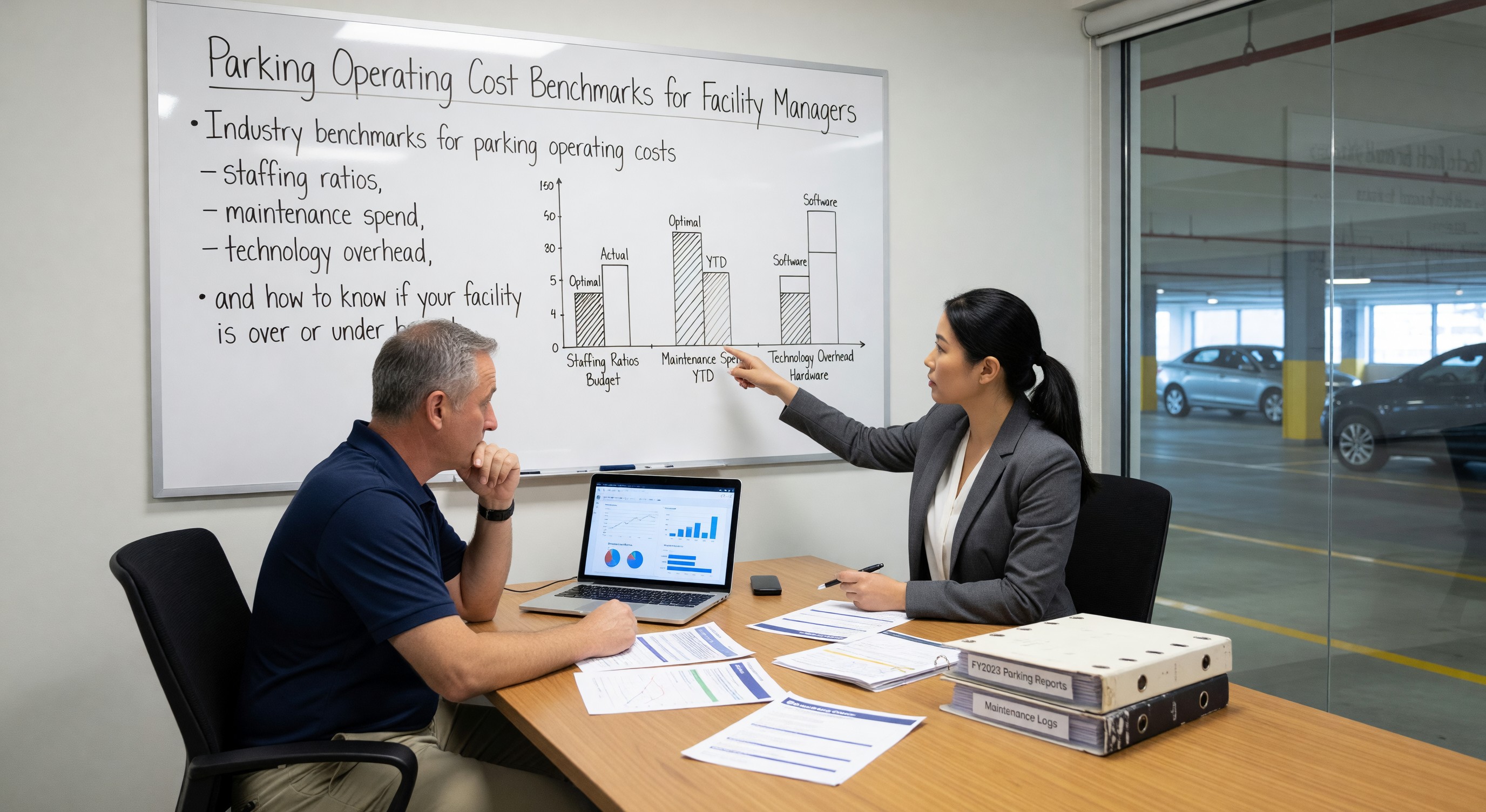
Understanding whether your parking operation is cost-efficient requires more than comparing last year to this year. It requires comparing your costs to what similar facilities spend. Without external benchmarks, a facility manager has no way to know whether a $2.50-per-space monthly maintenance cost is excellent, average, or a signal that deferred work is accumulating.
This guide consolidates benchmark ranges from BOMA, IPMI, and peer-reviewed facility management research to help you evaluate your parking operation against industry norms.
Why Benchmarking Parking Operations Is Difficult
Parking cost benchmarks are less standardized than benchmarks for other building systems. BOMA’s annual Experience Exchange Report covers parking as a component of overall facility costs but does not break out individual parking line items with the same granularity as HVAC or janitorial services.
IPMI (International Parking and Mobility Institute) publishes operating cost surveys periodically, but sample sizes for specific facility types can be small. This means that benchmarks should be treated as directional guidance, not hard targets.
The most useful benchmarking approach is peer comparison — finding facilities similar to yours in type, geography, and scale, and comparing directly. Regional parking associations and BOMA local chapters facilitate peer groups that enable this kind of comparison.
Staffing Cost Benchmarks
Staffing is the largest variable in parking operating costs. Facilities with full attendant operations have fundamentally different cost structures than automated facilities with remote monitoring.
For fully automated surface lots, labor costs typically run $8 to $15 per space per month, covering part-time monitoring, periodic auditing, and administrative overhead. For partially attended garages with booth coverage during peak hours, expect $18 to $35 per space per month. For fully attended operations with 24/7 coverage, costs range from $45 to $90 per space per month depending on local labor markets and whether the operation is self-managed or outsourced to a parking operator.
If your staffing costs fall significantly above these ranges, examine your coverage model first. Many facilities maintain staffing levels based on historical practice rather than current demand patterns. Traffic counts and transaction data often reveal opportunities to reduce coverage during consistently slow periods without affecting service levels.
Maintenance Cost Benchmarks
Maintenance costs for parking facilities vary by structure type. Surface lots have the lowest maintenance cost profile; above-grade garages have moderate costs; below-grade structures have the highest costs due to drainage, waterproofing, and mechanical system complexity.
For surface lots, maintenance costs typically run $0.50 to $1.50 per square foot per year. This covers line restriping, crack sealing, lighting maintenance, signage repair, and periodic sweeping. Lots with older pavement that need active rehabilitation will spend toward the top of this range or above it.
For above-grade parking structures, industry benchmarks from BOMA and the Precast/Prestressed Concrete Institute place routine maintenance at $1.50 to $3.50 per square foot annually. This includes concrete inspection, joint sealant maintenance, expansion joint repair, drainage maintenance, and coating systems upkeep.
Below-grade garages typically spend $3.00 to $6.00 per square foot annually on maintenance, with waterproofing maintenance and drainage systems representing disproportionate shares of that cost.
Technology and Equipment Benchmarks
Parking access and revenue control systems (PARCS) have associated ongoing costs that many budgets underestimate in the first year of ownership.
Software licensing and support typically runs 8 to 15 percent of the original PARCS purchase price annually. For a $200,000 system, that is $16,000 to $30,000 per year in software costs alone. Some vendors bundle support and licensing into a monthly SaaS fee; ensure you are comparing total cost of ownership rather than just purchase price when evaluating systems.
Hardware maintenance for gate arms, ticket dispensers, pay stations, and exit verifiers typically runs 5 to 10 percent of equipment value annually. Gate arms are high-frequency wear items — a heavily used entrance gate can cycle 300 to 500 times per day, and mechanical components require routine replacement.
License plate recognition (LPR) systems add camera maintenance, software licensing, and periodic calibration to the equipment cost base. Budget $800 to $1,500 per camera per year for maintenance and support.
Utility Cost Benchmarks
Lighting represents the dominant utility cost in most parking facilities. Before LED conversion, traditional metal halide and high-pressure sodium fixtures consumed 250 to 400 watts each. After LED conversion, equivalent fixtures consume 60 to 120 watts. Facilities that have not yet converted to LED lighting are spending significantly more on electricity than their peers.
Post-LED conversion, utility costs for surface lots typically run $0.20 to $0.50 per square foot annually. For garages with lighting, ventilation, and elevator systems, utility costs range from $0.75 to $1.75 per square foot.
Mechanical ventilation in enclosed garages represents a major utility cost. ASHRAE Standard 62.1 requires minimum ventilation rates for enclosed parking garages, but demand-controlled ventilation systems that modulate fan operation based on CO sensor readings can reduce ventilation energy use by 50 to 70 percent compared to constant-speed operation. If your garage uses constant-speed fans, the upgrade economics are almost always compelling.
Revenue per Space Benchmarks
Evaluating cost efficiency in isolation is incomplete. Cost benchmarks should be viewed alongside revenue per space to assess overall financial performance.
Urban surface lots in major markets generate $150 to $400 per space per month in gross revenue. Suburban surface lots generate $50 to $150 per space. Downtown structured parking ranges widely based on market rates but often achieves $100 to $350 per space per month.
An operation that spends $40 per space per month on operating costs but generates $300 per space in revenue is performing very differently than one that spends $40 per space and generates $60.
Using Benchmarks to Set Budget Targets
When setting annual budget targets, use benchmarks as a floor check rather than a target. If your maintenance spend is below the industry benchmark for your facility type, investigate whether deferred maintenance is the cause before congratulating yourself on efficiency.
Benchmarks also help you make the case for budget increases. When a department head pushes back on a maintenance request, the ability to show that peer facilities spend 40 percent more per square foot on maintenance than your facility currently does makes a more compelling argument than “the structure needs it.”
FAQ
How often should I re-benchmark my parking operation? Annually is reasonable for a quick self-assessment using published data. A full peer-comparison benchmarking exercise every three to five years provides deeper insight, especially if your facility has undergone changes in technology, management model, or utilization.
Should I include management fees in operating cost benchmarks? Yes. If you use a third-party parking operator, include their management fee in your operating cost calculations. Self-managed operations should include the allocated cost of facility management overhead for consistency.
My costs are higher than benchmarks. Does that mean I’m inefficient? Not necessarily. Higher-than-benchmark costs can reflect older facilities with higher maintenance needs, higher local labor markets, superior service levels, or a richer feature set. Use benchmarks as a prompt to investigate, not as a verdict.
Where can I find current benchmark data? IPMI (ipmi.com), BOMA International (boma.org), and regional parking associations publish periodic surveys. Local BOMA chapters often facilitate peer benchmarking groups for members.
Further Reading from Authoritative Sources
- International Parking and Mobility Institute operating cost resources — parking-mobility.org (IPMI) is on the whitelist as the primary parking industry authority and the most credible source for the operating cost benchmarks this article discusses.
- IFMA facility cost benchmarking studies — ifma.org is on the whitelist and its cross-property benchmarking data provides useful context for readers who manage parking as part of a broader facility portfolio.