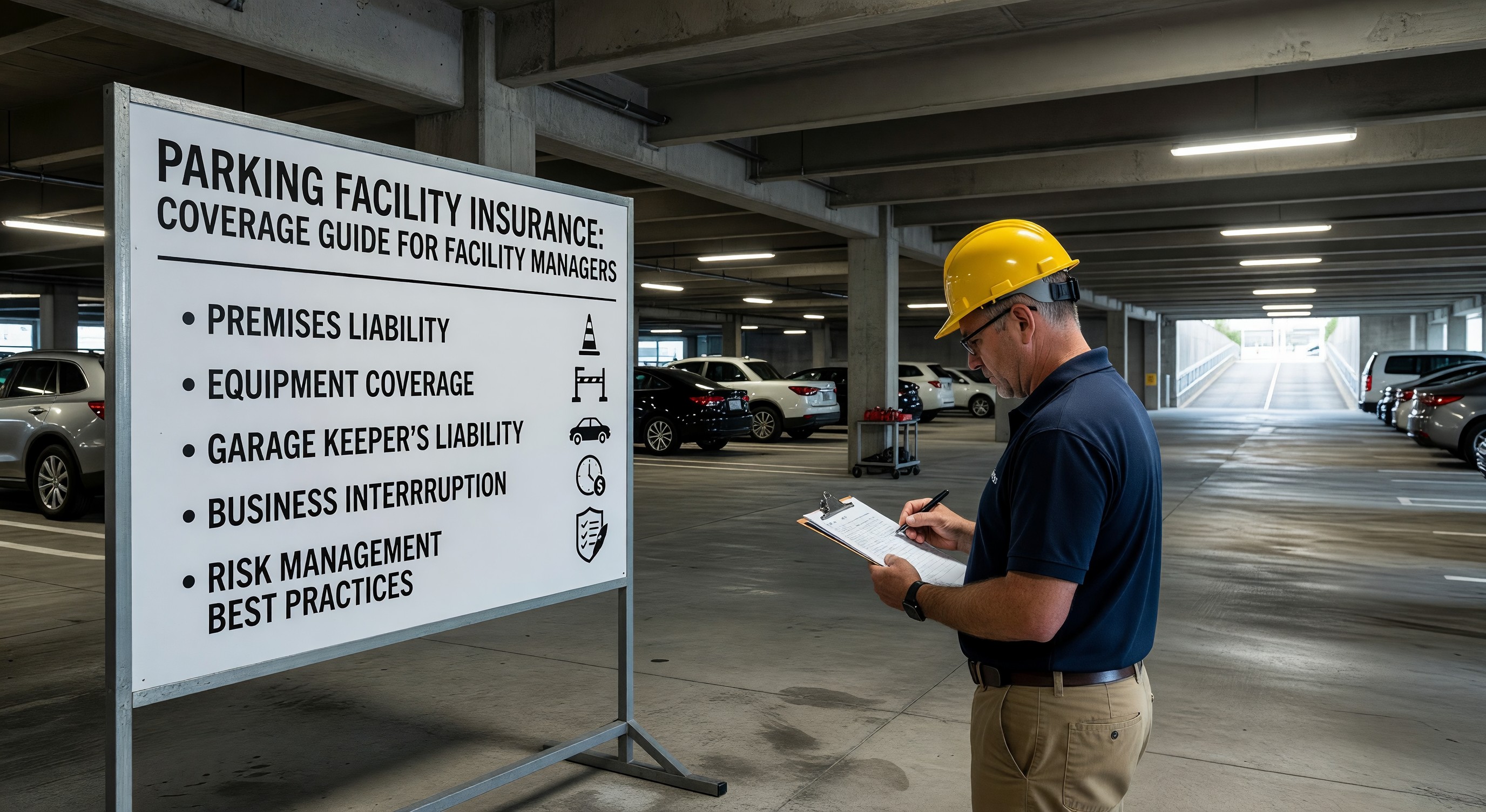
Parking facility insurance is one of the most misunderstood areas of facility risk management. Many facility managers assume their standard commercial property and liability policies cover parking operations adequately. This assumption is frequently wrong, and the gaps become apparent only after an incident.
This guide covers the insurance coverage types that parking facilities need, common coverage gaps, and risk management practices that reduce both incident frequency and insurance premiums.
Core Coverage Types for Parking Facilities
Commercial General Liability
Commercial general liability (CGL) insurance covers bodily injury and property damage claims arising from operations on your premises. For parking facilities, this covers incidents like a customer who trips on a damaged curb, a pedestrian struck in a drive lane, or a structural failure that injures an occupant.
CGL policies have per-occurrence and aggregate limits. For parking facilities with significant foot traffic, minimum per-occurrence limits of $1 million and aggregate limits of $2 million are standard. Facilities with high-value operations, significant pedestrian volume, or prior claims histories should carry higher limits.
Review your CGL policy for exclusions relevant to parking. Some policies exclude coverage for incidents in areas the policyholder does not own or occupy — this matters if your facility operates on leased land or manages parking in facilities owned by others.
Garage Keeper’s Legal Liability
Garage keeper’s legal liability (GKLL) coverage is specific to parking operations and covers damage to customers’ vehicles while they are in your care, custody, or control. Standard CGL policies explicitly exclude this exposure.
GKLL coverage is essential for attended parking operations where staff take possession of vehicles. Even for self-park operations, the question of whether a facility is legally liable for vehicle damage is complex and depends on jurisdiction, signage, and the circumstances of the incident. A significant vehicle damage claim without GKLL coverage can be devastating.
When evaluating GKLL coverage, confirm whether it is written on a direct damage or legal liability basis. Direct damage coverage pays regardless of fault. Legal liability coverage pays only when the facility is found legally liable. Direct damage coverage provides broader protection and is worth the premium differential.
Coverage limits for GKLL should reflect the value of vehicles your facility typically handles. Facilities that serve high-value vehicle markets (luxury residential, upscale hospitality) should carry higher per-vehicle limits.
Commercial Property Insurance
Commercial property insurance covers the physical structure of the parking facility against losses from fire, storm, vandalism, and other covered perils. For parking structures, ensure the policy’s replacement cost value accurately reflects the current cost to rebuild — parking structure replacement costs have increased significantly with labor and materials inflation.
Obtain a professional replacement cost appraisal every five years and after any significant renovation. Carrying insurance based on outdated replacement cost estimates means inadequate coverage when a total loss occurs.
Equipment is a separate coverage consideration. Revenue control systems, payment stations, lighting systems, and other equipment can be covered under a commercial property policy or under an inland marine equipment floater policy. Verify that your equipment coverage limits and replacement values are current.
Business Interruption Insurance
Business interruption coverage replaces lost revenue and covers ongoing fixed expenses if the facility must close due to a covered physical damage event. For parking operations that generate significant daily revenue, a closure of even two or three weeks can represent a material financial loss.
When selecting business interruption coverage, the most important consideration is the waiting period (the period before coverage kicks in) and the indemnity period (the maximum duration of coverage). Parking facility repairs can be lengthy — a structural repair or equipment replacement may take 60 to 120 days or more. Your indemnity period should reflect realistic repair timelines.
Umbrella and Excess Liability
Umbrella policies provide additional liability coverage above the limits of your underlying policies. For parking facilities exposed to serious injury incidents — vehicle-pedestrian collisions, structural failures, security incidents — umbrella coverage provides protection against claims that exhaust primary policy limits.
Umbrella coverage is typically cost-effective relative to the protection it provides. Most parking facilities should carry umbrella limits of at least $5 million; high-traffic or high-exposure facilities should evaluate $10 million or higher.
Common Coverage Gaps in Parking Facilities
Security incident liability. Incidents involving assaults, carjackings, or other crimes on parking premises can generate significant liability claims. Some CGL policies exclude or limit coverage for criminal acts on premises. Review your policy specifically for security-related exclusions, particularly if your facility has had prior security incidents.
Contractor and vendor liability. When contractors perform work on your facility, verify their insurance requirements before work begins. Contractors should carry their own CGL and workers’ compensation insurance, and name your facility as an additional insured. Without this, their employees’ on-site injuries may become your claim.
Third-party managed facility coverage. If you use a third-party parking operator, the division of coverage between your policy and the operator’s policy must be clearly defined. Gaps at the boundary — claims where both parties argue the other’s policy applies — are expensive to resolve. Work with both insurers to clarify coverage assignment before an incident occurs.
Flood and water damage. Below-grade parking structures have elevated flood risk. Verify that your property policy covers water intrusion and flooding, and consider whether supplemental flood coverage is warranted if your facility is in a flood-prone area.
Risk Management Practices That Reduce Claims
Proactive risk management reduces both claim frequency and insurance premiums. Key practices:
Regular safety inspections. Document regular inspections of drive surfaces, pedestrian areas, lighting, and structural conditions. Inspection records demonstrate due diligence and are valuable in defending against premises liability claims.
Slip and fall prevention. Parking facilities are high-risk environments for slip and fall incidents. Maintain drive lanes and pedestrian paths in good repair, promptly address water intrusion that creates slip hazards, and maintain adequate lighting throughout the facility.
Signage and traffic management. Clear speed limit signage, stop signs, pedestrian crossing markings, and directional signage reduce accident risk. Facilities that have not reviewed their traffic management signage in several years often find significant opportunities for improvement.
Incident documentation procedures. Establish clear procedures for documenting incidents that occur in the facility. Prompt incident reports, photographs, and witness information preserved at the time of an incident significantly improve your ability to respond to claims.
FAQ
What is the difference between garage keeper’s liability and valet liability? Garage keeper’s legal liability covers damage to vehicles in your care, custody, and control regardless of how they arrived. Valet liability is a specific form of coverage for valet operations where staff drive customer vehicles. If you operate valet parking, confirm your policy specifically covers valet operations, including incidents that occur during vehicle retrieval on public streets.
Does signage disclaiming liability eliminate the need for garage keeper’s coverage? No. While disclaimer signage may limit liability in some jurisdictions and circumstances, it does not eliminate the risk of liability and does not substitute for insurance coverage. Courts regularly find parking facilities liable for vehicle damage despite disclaimer signage. Carry the coverage.
How often should I review my parking facility’s insurance program? Annually, and whenever there is a significant change in operations, facility value, or revenue. Annual insurance reviews with your broker should include a coverage adequacy check, premium benchmarking, and a review of any claims activity that may affect future premiums.
What documentation should I keep to support insurance claims? Maintain current appraisals for the facility and equipment, up-to-date revenue records for business interruption claims, inspection and maintenance logs, incident reports, and photographs of the facility’s condition before and after any damage event.
Further Reading from Authoritative Sources
- International Parking and Mobility Institute risk management resources — parking-mobility.org (IPMI) is on the whitelist as the primary parking industry authority with parking-specific insurance and risk management resources for facility operators.
- BOMI International facility risk management education — bomi.org is on the whitelist as a facility management authority whose risk management curriculum covers the insurance decision frameworks discussed in this article.