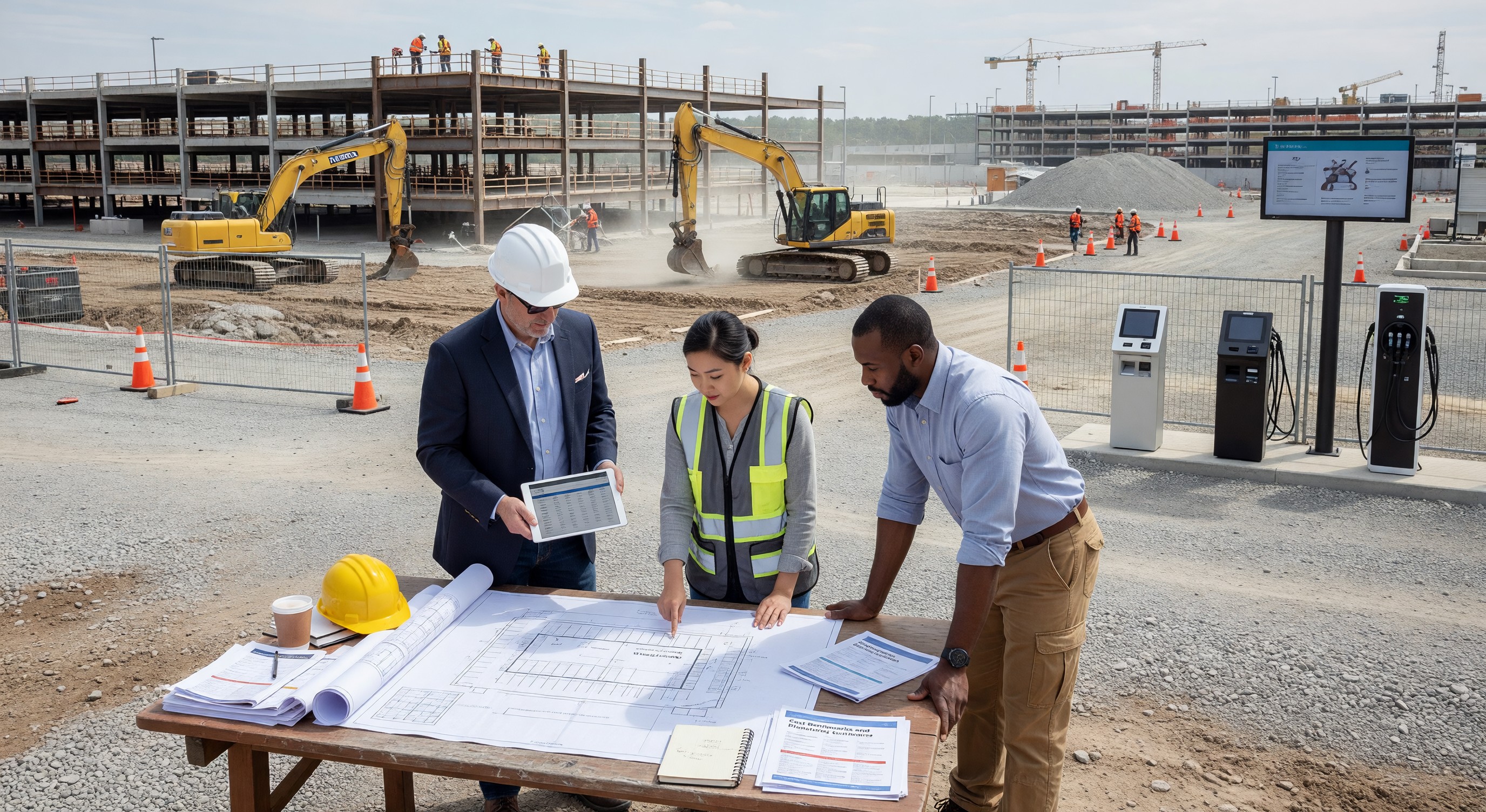
Parking construction and renovation projects are among the most capital-intensive decisions facility managers face. A surface lot expansion, structured garage addition, or major facility renovation can consume years of operating profit. Getting the cost planning right before committing to a project prevents the budget overruns and scope reductions that plague poorly planned parking capital projects.
This guide provides current cost benchmarks, the cost drivers that create the widest variance, and the planning framework for accurate parking construction budgets.
Surface Lot Construction Costs
Surface lots are the least expensive parking to build but involve more cost variability than many facility managers expect.
Base site work for a new surface lot typically costs $2,000 to $5,000 per space for grading, drainage, subbase, and asphalt paving. This range reflects significant variation based on site conditions — a level, well-drained site at the low end versus a site requiring significant cut and fill, retaining walls, or complex drainage at the high end.
Striping and signage adds $200 to $500 per space. Lighting for new surface lot construction runs $500 to $1,500 per space depending on fixture type, pole height, and electrical run lengths. LED lighting is standard for new construction and will be at the lower end of the range for comparable light levels.
Revenue control equipment for a new surface lot — entry/exit gates, pay stations, and installation — typically runs $40,000 to $120,000 for a basic single-entry, single-exit configuration. More complex sites with multiple access points, LPR integration, or mobile-first technology add cost.
Total surface lot construction cost for a well-located, standard-condition site with revenue control: $3,000 to $7,500 per space. Sites with challenging conditions or premium technology can exceed $10,000 per space.
Structured Parking Construction Costs
Structured parking — above-grade or below-grade garages — costs far more per space than surface parking but enables higher-density land use.
Above-grade precast concrete structures are the most common commercial parking structure type. New construction costs have risen significantly since 2020 due to materials and labor inflation. Current benchmarks:
- Single-level open structure: $12,000 to $18,000 per space
- Multi-level above-grade structure: $18,000 to $28,000 per space
- Premium finishes, complex sites, urban markets: $28,000 to $45,000+ per space
These costs include the structure, mechanical and electrical systems, fire protection, and basic revenue control infrastructure. They typically exclude land cost, site work beyond the structure footprint, and above-standard technology.
Below-grade (underground) parking is substantially more expensive. Excavation, waterproofing, mechanical ventilation requirements, and longer construction timelines all add cost. Expect $35,000 to $65,000 per space for below-grade construction, with premium urban sites reaching $80,000 to $100,000 per space or more.
Major Renovation Cost Benchmarks
Existing parking facilities require periodic major renovation to maintain condition and functionality. Key renovation cost benchmarks:
Deck waterproofing and coating: $15 to $40 per square foot for full deck restoration, including concrete repair, crack treatment, and traffic deck coating system. Facilities with significant concrete deterioration or delamination will fall at the high end of this range.
LED lighting retrofit (existing structure): $75 to $200 per fixture installed, including fixture cost and electrical work. Projects where new circuits must be run from remote panels are at the high end.
PARCS system replacement: $150,000 to $600,000 for a complete system replacement in a mid-size facility, including hardware, software, installation, training, and integration. Larger facilities and those with complex configurations are at the high end.
Elevator modernization: $80,000 to $200,000 per elevator for control system and major component modernization. Full elevator replacement runs $200,000 to $500,000 or more depending on size and configuration.
Waterproofing and expansion joint repair: $20 to $60 per linear foot for expansion joint replacement. Joint work is often required in conjunction with deck restoration.
Cost Drivers That Create Wide Variance
Several factors create the most significant cost variance in parking construction and renovation:
Site conditions. Soil bearing capacity, groundwater, existing utilities, and topography all affect cost. Geotechnical investigation before any parking construction project is essential — discovering unfavorable site conditions during construction rather than before is one of the most expensive surprises in facility projects.
Market conditions. Construction costs have been volatile since 2020. Labor shortages, materials escalation, and supply chain disruptions have created significant variation between when cost estimates are prepared and when projects go to bid. Build escalation contingencies into long-horizon budgets.
Regulatory requirements. ADA compliance, local fire codes, seismic requirements, and stormwater management requirements vary significantly by jurisdiction and can add $2,000 to $5,000 per space to base construction costs in high-regulation markets.
Owner requirements. Premium finishes, above-standard technology, sustainability certifications, and unique design elements add cost over standard construction. Quantify these requirements clearly before budgeting.
Contingency and Escalation Planning
Parking construction projects consistently exceed initial budget estimates when contingencies are inadequate. Standard contingency recommendations:
- Design contingency (pre-construction): 15 to 20 percent of estimated construction cost
- Construction contingency (during construction): 8 to 12 percent of construction contract value
- Escalation contingency: 3 to 5 percent per year between estimate date and projected construction completion
These contingencies should not be removed during value engineering unless the risk factors that justify them have been specifically resolved. Projects that strip contingencies to hit a target budget number often face the original contingency amount (or more) in change orders.
Procurement Approach and Its Cost Impact
How you procure construction services significantly affects cost and risk.
Design-bid-build is the traditional approach: design complete, then publicly bid to general contractors. This provides competitive pricing but requires a complete design before costs are known, and change orders during construction can be expensive.
Design-build delivers design and construction through a single contract. It can provide faster delivery and more predictable costs if the design-builder is selected competitively with a clear scope. It provides less owner control over design details.
Construction Manager at Risk (CMAR) involves engaging the contractor during design to provide cost input and preconstruction services, with a guaranteed maximum price commitment before construction begins. This model can reduce design-phase cost risk and improve constructability.
For parking projects, getting contractor input on major cost items — structural system type, equipment selections, site logistics — during design often produces the most cost-effective outcomes.
FAQ
What is the right level of planning for a preliminary budget? Preliminary budgets based on per-space benchmarks are appropriate for initial feasibility analysis. For project approval and financing, invest in at least a concept design with an independent cost estimate. Per-space estimates carry ±30 to 40 percent accuracy; estimate-quality cost assessments can achieve ±15 to 20 percent.
How much should I budget for professional fees? Architect and engineer fees for parking projects typically run 6 to 12 percent of construction cost for full design services. Simpler projects (surface lots, renovation with limited design scope) are at the low end; complex new structures are at the high end.
What warranty periods should I expect for parking construction? Standard commercial construction warranties are one year for general construction. Deck coating systems from reputable manufacturers typically carry 5 to 10 year material warranties. Structural concrete should be specified with 5-year workmanship warranties for major defects.
Is it worth getting multiple bids for renovation projects? Yes. For projects above $50,000, competitive bidding (three or more qualified bidders) consistently produces better pricing than single-source procurement. Prepare a complete scope of work document before soliciting bids to ensure you are comparing apples to apples.
Further Reading from Authoritative Sources
- U.S. Department of Transportation parking infrastructure resources — transportation.gov is on the whitelist and serves as the federal authority on transportation infrastructure planning, providing relevant context for parking construction cost benchmarks.
- International Parking and Mobility Institute construction planning guidance — parking-mobility.org (IPMI) is on the whitelist as the primary parking industry authority and publishes practical construction planning guidance for the exact audience this article serves.