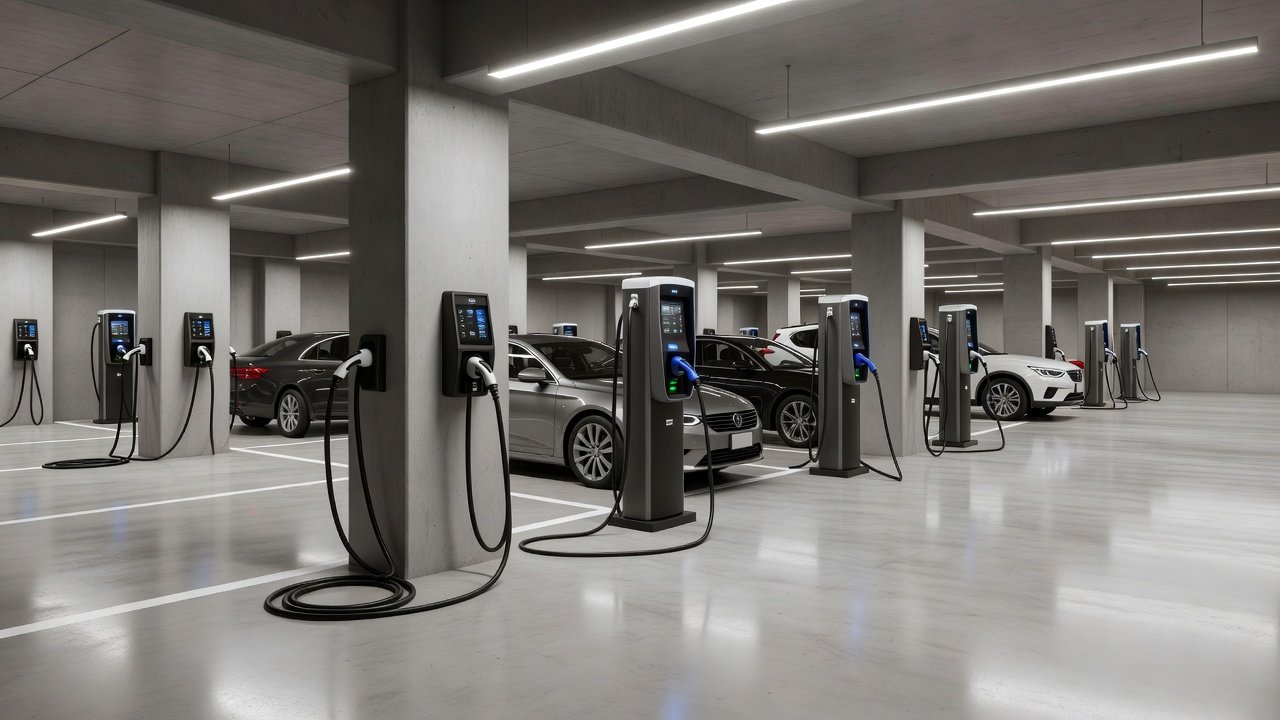
The model of managing parking and EV charging as separate systems is ending. What was once a tenant amenity has become a baseline expectation at office buildings, medical campuses, and mixed-use properties. Facilities that do not have a credible EV charging plan heading into late 2026 are behind — and operating at a disadvantage as lease renewals come up and tenant requests pile in.
For facility managers, the integration challenge is not just about buying chargers. It involves grid assessment, panel capacity, utility coordination, software integration with your existing parking access and revenue control (PARC) system, and a revenue model that recovers costs over time. Each piece affects the others.
Start With a Grid and Panel Assessment
Before any EV charging project is scoped, a licensed electrician or commissioning engineer needs to assess the facility’s existing electrical infrastructure. The core questions are simple but the answers determine the entire project scope.
How much panel capacity is currently unused? Each Level 2 commercial charging station requires a dedicated 240V circuit, typically 40 to 50 amps. A facility installing 10 Level 2 stations simultaneously needs 400 to 500 amps of available capacity — more than many parking facility panels were originally designed to carry.
If available capacity is insufficient, there are two paths: panel upgrade or smart load management. Panel upgrades in commercial facilities range from $5,000 to $30,000 depending on scope. In some cases, a subpanel installed near the charging zone reduces the cost of long conduit runs from the main panel. Smart charge management systems take a different approach — they dynamically throttle charging speeds across all stations based on available grid capacity, preventing simultaneous peak draw without requiring a full panel upgrade.
For facilities where the utility service entrance itself is undersized, adding significant EV charging load may trigger a utility service upgrade. These projects involve the utility company directly, can cost $20,000 to $100,000, and historically take six months to a year to complete. Engage your utility’s commercial representative before finalizing project scope — a utility upgrade requirement can reset your project timeline entirely.
The 30C Tax Credit Window
The Alternative Fuel Vehicle Refueling Property Credit (IRS Section 30C) has been extended through June 30, 2026, creating a defined deadline for commercial properties seeking federal tax support for EV charging installations.
Under the current structure, commercial properties can claim 6% to 30% of qualifying equipment and installation costs, up to $100,000 per installed charging port. The 30% rate applies to projects meeting prevailing wage and apprenticeship requirements under IRS guidance. Projects located outside qualifying census tracts or that do not meet wage requirements qualify for the base 6% rate.
To claim the credit, the equipment must be placed in service — meaning fully installed, inspected, and operational — before the deadline. A project that signs contracts in May 2026 but does not complete utility coordination and final inspection before the June 30 deadline would not qualify. Given utility company lead times, facilities that have not yet initiated their projects should assess immediately whether the 30C window is still achievable for their specific situation.
State-level incentives and utility rebate programs are separate from the 30C federal credit and often stack with it. Many electric utilities offer rebates for commercial EV charging equipment and may provide preferential commercial rate structures for EV charging load. These programs are not advertised aggressively — contact your utility’s commercial account manager directly to ask what is available.
Hardware Selection: What Matters for Commercial Facilities
Level 2 networked charging stations are the appropriate technology for most commercial parking facilities. Level 1 (standard 120V) is too slow for commercial use. DC fast chargers (DCFC) are appropriate for high-turnover transient facilities — highway corridors, retail anchors with short dwell times — but carry equipment costs of $30,000 to $150,000 per unit and substantial infrastructure requirements.
For a standard office, medical, or mixed-use parking facility, networked Level 2 stations at $2,000 to $4,500 per port are the correct starting point. “Networked” means the equipment connects to a cloud platform that enables session management, remote monitoring, usage reporting, and fee collection. Non-networked (dumb) chargers cost less upfront but eliminate your ability to charge for sessions, track usage by tenant or permit holder, manage load across stations, or troubleshoot remotely.
When evaluating networked equipment, the vendor’s software platform matters as much as the hardware. Look for platforms that support the Open Charge Point Protocol (OCPP) — the industry communication standard — which allows you to switch network operators without replacing hardware. Proprietary platforms that lock hardware to the vendor’s network create vendor dependency that becomes a liability during contract renewals.
Integration With Your Existing PARCS Platform
The most operationally efficient EV charging installations tie charging session data directly into the parking access and revenue control system. When a driver enters the facility, validates a parking session, and initiates charging, a fully integrated system handles payment for both in a single transaction.
In practice, integration depth varies significantly by PARCS vendor. Some platforms have native OCPP support or certified connectors to major EV networks. Others require API development or middleware. Before selecting an EV charging vendor, confirm how their platform interacts with your existing PARCS system — and get any integration commitments in writing in the contract. Retrofitting integration after installation is expensive and sometimes not technically feasible.
Pricing EV Charging as a Revenue Line
The decision of whether to charge for EV charging — and how — is as important as the infrastructure decision itself.
Fee-per-use: Per-kWh or per-hour charging rates through the networked platform. Requires utility rate knowledge to set margins correctly; allows full cost recovery over time.
Permit tier bundling: A premium permit tier that includes EV charging access, typically priced at a $30 to $80 per month premium over standard monthly permits. Simplifies billing and provides predictable revenue; may undervalue high-demand charging in facilities where charger availability is constrained.
Network revenue sharing: Some EV network operators offer to supply equipment at reduced cost in exchange for a revenue share and multi-year exclusivity. These arrangements reduce capital outlay but limit pricing control and create contractual lock-in. Evaluate the five-year economics carefully — revenue-sharing agreements that made sense at low EV penetration may become costly constraints as charging demand grows.
Tenant and employer programs: Corporate campuses and office facilities may be able to structure arrangements where tenant employers pay for employee charging as a benefit. The facility collects equipment lease revenue; the employer handles the benefit program.
Planning for Demand Growth
Most commercial facilities that install EV charging discover that demand grows faster than the initial deployment anticipated. Building for scale during the initial project is meaningfully cheaper than phased retrofits.
Installing conduit runs to locations that will need chargers in phase two — even without equipment — during the initial project costs $300 to $800 per stub-out. Installing that conduit later in a finished facility can cost three to five times more. Similarly, sizing panel upgrades and utility service work for future load rather than only current load adds modest incremental cost during the initial project and avoids a second upgrade cycle.
The Department of Energy’s Alternative Fuels Data Center maintains current data on EV adoption rates by geography and vehicle class, useful for projecting 5- to 10-year demand at a specific facility type. IPMI’s resources on EV integration in parking operations provide parking-specific frameworks for evaluating deployment scale and phasing.
Starting with 5 to 10 percent of spaces equipped and planning for 20 to 30 percent over five years is a reasonable baseline for most commercial facilities in markets with above-average EV adoption. Facilities in lower-adoption markets can start smaller, but the infrastructure groundwork — conduit, panel capacity, utility coordination — should still be sized for eventual expansion.
The facilities that get this right in 2026 will not be the ones with the most chargers. They will be the ones that treat EV charging as an integrated operational system from the start — with infrastructure sized for growth, software that connects to existing platforms, and a revenue model that makes the investment recoverable.