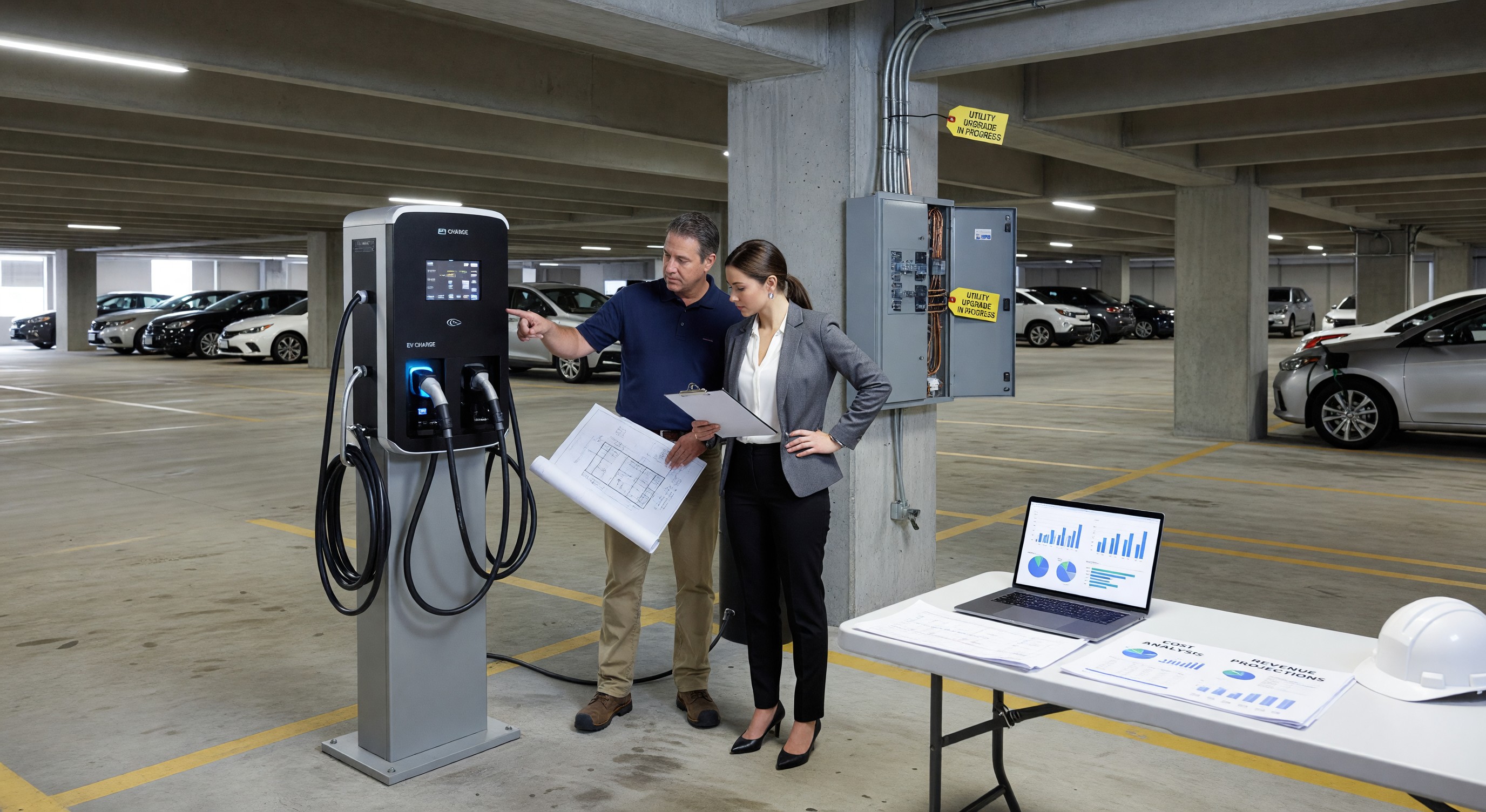
Electric vehicle charging infrastructure has moved from a differentiator to an expectation in commercial parking facilities. Office tenants, healthcare employers, retail anchors, and residential occupants increasingly ask about charging availability before committing to spaces. Facility managers who have not yet developed a charging strategy are behind.
The challenge is that EV charging infrastructure involves significant capital investment, complex utility coordination, and ongoing operational costs that many initial facility budgets underestimate. This guide provides a complete picture of what EV charging installation costs, how to evaluate financial models, and how to plan a deployment that scales with demand.
Understanding the Charging Level Landscape
EV charging equipment is categorized by charging speed, which determines both the use case and the infrastructure cost.
Level 1 (120V AC): Basic household-outlet charging. Provides roughly 3 to 5 miles of range per hour of charging. Adequate only for overnight residential charging. Not appropriate for commercial parking facilities as the primary offering.
Level 2 (240V AC): The standard for commercial facility charging. Provides 20 to 30 miles of range per hour, fully charging most EVs in 4 to 10 hours. Equipment costs $1,500 to $5,000 per charging port. Electrical infrastructure requirements are manageable in most facilities.
DC Fast Charging (DCFC): Provides 100 to 250 miles of range per hour or more. Appropriate for high-turnover locations (retail, highway corridors) where fast charging justifies the premium. Equipment costs $30,000 to $150,000 per unit. Electrical infrastructure requirements are substantial and may require transformer upgrades.
For most commercial parking facilities — offices, medical, mixed-use, structured parking — Level 2 charging is the appropriate technology. DCFC may be appropriate for facilities with high-turnover transient parking if demand justifies the cost.
Cost Components for Level 2 Installation
A complete budget for Level 2 EV charging must account for all cost components, not just equipment purchase.
Equipment cost: Networked Level 2 charging stations typically cost $2,000 to $4,500 per port, including the charging unit and network enrollment fees. Non-networked (dumb) chargers cost less but lack usage tracking, remote management, and fee collection capability. For commercial facilities, networked equipment is essential.
Electrical panel and circuit work: Each Level 2 charger requires a dedicated 240V circuit, typically 40 to 50 amps. Running conduit and wiring from the electrical panel to charging locations is often the largest cost variable. In facilities where charging is near the panel, costs may be $1,000 to $2,000 per circuit. In facilities where long runs are required, costs can reach $5,000 to $15,000 per circuit.
Panel upgrades: Many parking facility electrical panels were sized before EV charging was contemplated. Adding multiple Level 2 chargers simultaneously can exceed available panel capacity. Panel upgrades range from $5,000 to $30,000 depending on scope. Power distribution upgrades (adding a subpanel near charging locations) can reduce long-run conduit costs.
Utility service upgrades: In some facilities, adding significant EV charging load requires upgrading the utility service entrance to the building. This is a utility project, not just a facility project, and can cost $20,000 to $100,000 and take six months or more to complete. Engage your utility company early to understand whether service upgrades will be required.
Permitting and inspection: Building permits for electrical work, inspections, and any required engineering drawings add cost. Budget $1,000 to $5,000 per project depending on jurisdiction.
Network setup and integration: Networked chargers require configuration, network enrollment, and integration with building management systems or payment systems. These setup costs are typically $500 to $2,000 for standard deployments.
Total installed cost: For a typical 10-charger Level 2 deployment in a commercial parking facility, expect total installed costs of $50,000 to $150,000 depending on facility conditions, run lengths, and whether panel upgrades are required.
Revenue and Cost Recovery Models
Facility managers have several models for recovering EV charging costs.
Fee-per-use charging: Set a per-kWh or per-hour rate for EV charging. Networked chargers enable access control, usage tracking, and fee collection. Revenue from user fees can offset operating costs and, over time, contribute to capital recovery. Rate setting requires understanding your utility cost per kWh and building in margin for equipment maintenance and network fees.
Subscription or permit bundling: Include EV charging as an amenity in a premium monthly permit tier. This simplifies billing and captures incremental permit revenue from EV owners willing to pay for reserved access to charging.
Network revenue sharing: Several EV network operators (ChargePoint, Blink, EVgo) offer revenue-sharing arrangements where they supply equipment at reduced cost in exchange for a share of charging revenue. These models reduce capital outlay but give up control over pricing and long-term flexibility. Evaluate contract terms carefully — long exclusive agreements can become a constraint as the technology evolves.
Employer programs: Corporate campuses and office buildings can partner with tenant employers who offer EV charging as a benefit to employees. The employer pays for employee charging usage, and the facility earns lease revenue for the charging infrastructure.
Federal and State Incentives
Federal tax credits and state incentive programs can significantly reduce the net cost of EV charging installation. The Alternative Fuel Vehicle Refueling Property Credit (IRS Form 8911) provides a federal tax credit of up to 30 percent of charging equipment and installation costs for commercial properties, subject to caps. State-level incentives vary widely and can supplement federal credits.
Utility-sponsored programs are also common. Many electric utilities offer rebates for EV charging equipment and installation, along with preferential rate structures for EV charging load. Contact your utility’s commercial program representative before finalizing your project budget — utility incentives can reduce net costs by 20 to 50 percent.
Planning for Future Scale
Most facilities install initial EV charging capacity and discover that demand grows faster than anticipated. Planning for future scale from the start reduces the cost of later expansion.
Conduit stub-outs: Installing conduit runs to potential future charging locations during the initial project, even without equipment, dramatically reduces the cost of later expansion. A conduit stub-out costs $300 to $800; adding conduit later in a finished facility can cost three to five times as much.
Panel capacity reservations: Size panel and service upgrades for future load, not just current load. The incremental cost of additional panel capacity during an upgrade project is typically much less than a second panel upgrade project later.
Smart charging and load management: Networked charging systems with load management capability can optimize charging schedules across multiple stations, preventing simultaneous peak load events that would otherwise require larger electrical infrastructure.
FAQ
How do I estimate EV charging demand for my facility? Start with current EV penetration among your facility users. Survey monthly permit holders or tenants about their current and planned EV ownership. Use national EV adoption forecasts from the Department of Energy or regional grid operators to project 5-year demand. Most commercial facilities start with 5 to 10 percent of spaces and plan for eventual expansion to 15 to 25 percent.
Should I install EV charging in all spaces or just designated spaces? Designated charging spaces are standard for Level 2 commercial charging. Clearly marked spaces with appropriate signage prevent non-EV vehicles from occupying charging spots. Some facilities have moved to requiring EV occupancy for designated spaces; enforcement should be addressed in your parking rules.
What liability considerations apply to EV charging? Review your insurance policy to confirm that EV charging operations are covered under your premises liability program. Equipment defects that cause vehicle fires or electrical damage are a real (if uncommon) risk. Confirm that your general liability coverage extends to EV charging operations and consider whether equipment-specific coverage is warranted.
How long does a typical EV charging installation project take? For straightforward Level 2 installations without utility service upgrades, allow 60 to 120 days from project initiation through completion. Utility service upgrades can add 6 to 12 months. Begin utility coordination as early as possible in the project planning process.
Further Reading from Authoritative Sources
- U.S. Department of Energy EV charging infrastructure guidance — energy.gov is on the whitelist and is the primary federal authority on EV infrastructure investment, incentive structures, and technical standards — directly relevant to the tax credit and utility program discussion in this article.
- International Parking and Mobility Institute resources on EV charging — parking-mobility.org (IPMI) is the primary parking industry authority on the whitelist and offers parking-specific EV deployment guidance that complements the DOE’s technical perspective.